Tag Archives: family

Chapter 4: When the Yoke Must Shift

Introduction: The Weight You Didn’t Know You Were Carrying

Chapter 1: When Parenting Becomes a Load

Chapter 2:  Anxiety Is a Yoke Too

Chapter 3:  The Validation Yoke (When Comfort Stops Helping)

Every parent eventually reaches a moment when they realize the weight they have been carrying for their child; emotionally, spiritually, financially, relationally, has become unsustainable. What starts off as wisdom for the child can start to feel like pressure on the child. What was once protection for the child now feels like a burden to the child. 

And this moment is not failure. It’s maturity of the parent-child relationship. It’s the moment the yoke must shift. Not removed. Not abandoned. But shifted from your shoulders as a parent to their shoulders as the child becomes an adult.  

But it’s easier said than done as a parent. Loving parents often struggle to release the weight of adulthood because they confuse two things: “If I let go, they might suffer.” “If they suffer, I must have failed.” But both statements are untrue.

Here’s the part no parent wants to admit but every parent eventually learns: Suffering in the life of the child is not a sign of failure in the life of the parent or the child.  Repeat that to yourself.  There’s no parenting strategy, summer camp, private school or family camping trip that can protect a child from experiencing suffering in life.

In fact, when a child begins to experience suffering, it is a sign that the yoke is finally where it belongs. The child is feeling the weight of life on their shoulders. This hardship, which is perceived as negative by parents and children, is actually a means of grace to draw our children to faith in Jesus.

Whether the reader is religious or not, the principle is universal: Growth in life requires friction. Strength comes from struggle. You cannot develop muscles without tension, faith without uncertainty, or character without consequences, therefore, our adult children cannot develop into the fullness of who they are becoming if a parent continues to carry the weight life, or even parts of the weight, that are intended for the adult child.

Most parents are going to push back on this, because most parents instinctively want to protect their children from pain. That’s natural. But there’s a subtle trap in that pursuit of protection. 

  • If I push, they’ll pull away.
  • If I set boundaries, they’ll withdraw.
  • If I correct, they’ll shut down.
  • If I share truth, they’ll think I don’t love them.

This is a yoke of fear as a parent, and it doesn’t belong to the parent. It belongs to the child. And a parent has to recognize it before they can release it.  Often times, the biggest challenge to a parent recognizing it is because parents put too much pressure on themselves to provide a “successful launch” into adulthood. 

As a parent, we think to ourselves, “I want my child to have good social skills, be able to do some laundry, budget money, navigate a romantic relationship, keep up with responsibilities, manage their health and hygiene, work a job, and take the necessary steps to prepare for college or work after high school.” It’s a lot! 

What child transitioning into adulthood wouldn’t struggle.  It isn’t realistic to not see struggle. There are going to be bumps and those bumps in the life of our children isn’t a sign of their failure or our failure as parents, but instead those bumps are a sign that those children are beginning to carry the yoke of adulthood.  That’s a win!

Most launches into adulthood look great on the outside and on Instagram, but on the inside, there are a lot of start-stop transitions into adulthood. There are bursts of growth and seasons of plateau. Maybe even regression? 

From the parent’s perspective there are going to be times of confusion, and from the child’s perspective there are going to be times of frustration. There are going to be times it looks like the child is ready to embrace adulthood. And there are going to be times when the child is going to reject adulthood because of the discomfort that comes with it. This is why the parents can’t remove that yoke or try to carry it for them. It doesn’t mean parents disappear in those moments of one step forward and two steps back, but instead we are repositioning ourselves in their lives from carrier to companion. 

This transition isn’t going to be smooth for the parents as well. As a parent we have spent 20-years pouring our heart and soul into our children. We’ve played with them, cried with them, fought for them, cheered for them, cuddled with them; it’s a great season.  

But that season is over and a new season is coming, therefore, we want to grieve what was, celebrate those memories, and begin to cast a new vision for a new season where we will make new memories and share new experiences.  

The Cost of Carrying What Isn’t Yours

When parents keep carrying weight that belongs to their adult child, four predictable outcomes appear:

  1. Emotional Exhaustion
    • You become depleted.
    • Your nervous system stays in high alert.
    • You anticipate their emotional storms before they come.
  2. Resentment
    • You start feeling taken advantage of, even when your child doesn’t intend it.
    • You feel like your investment is wasted.
    • Your patience shortens.
  3. Defensive Parenting
    • You respond out of self-preservation instead of clarity.
    • This is when conversations turn sharp, not wise.
  4. Delayed Maturity
    • Your child never develops the internal muscle needed to carry their own life.

Chapter 4 Action Step: “Transferring the Weight Where it Belongs”

Choose one specific area where you have been carrying weight for your adult child:

Examples include:

  • managing their emotions
  • protecting them from consequences
  • supporting them financially
  • reminding them of responsibilities
  • rescuing them socially
  • regulating their anxiety
  • managing their calendar
  • filling the relational gap their partner leaves

Pick only one. Then write one sentence:

This area _____________________________ belongs to them, not me. I am going to take a clear action step of ________________________________ to signal the transfer of ownership.

Examples include:

  • stop reminding
  • stop rescuing
  • stop softening the truth
  • stop covering a bill
  • stop absorbing their anxiety
  • stop tiptoeing around a topic

Remember, you’re not abandoning your children in these moments. You are positioning them for strength. A shifted yoke doesn’t create distance. It creates maturity.

Chapter 3:  The Validation Yoke (When Comfort Stops Helping)

Introduction: The Weight You Didn’t Know You Were Carrying

Chapter 1: When Parenting Becomes a Load

Chapter 2:  Anxiety Is a Yoke Too

One of the most confusing parts of parenting an adult child is learning when comfort helps and when comfort backfires. Because comforting our children is good and comforting our children can heal.

But comfort can also hinder a child’s growth into adulthood. And most parents don’t know they’ve crossed that line until the relationship starts straining under the weight of it. So that the same yoke meant to help children step into adulthood can become something the parent takes on unnecessarily.  

When someone you love is anxious, exhausted, overwhelmed, or hurt, the first instinct is usually to validate, encourage and comfort.  We say things like, “I get it.” “That makes sense.” “Anyone would feel that way.”

Those sentences matter. They communicate presence. They reduce shame. They lower emotional volume. But validation alone is incomplete. Here’s what I learned: Validation calms emotions but can accidentally confirm the narrative fueling the anxiety.

Your child could hear, “You’re right to be afraid.” “Your worst-case scenario is probably true.” “Your interpretation of this situation is accurate because you’re overwhelmed.” For a young adult already living with high internal pressure, self-critique, and fear of being exposed, that kind of validation feels like relief, but it also quietly reinforces their most unstable thoughts.

The parent’s intent is comfort, but the child’s interpretation can become confirmation. And, as a result, the emotional weight doubles. This is why it is imperative for the child to take on their own yoke as an adult.  

When our children feel fear it isn’t panic it’s their perception of reality.  It is their brain focusing on short-term thinking.  It is self-protection.  It is image management.  When someone is in this mental state they usually aren’t able to hear all perspectives.  It is a loud alarm going off in their brain, “This is horrible!”

Suggestions aren’t going to usually make a dent, because “danger” is screaming at them in this emotional and mental state, so when a parent validates the emotion and the interpretation, fear gains more authority, not less.

Validation then becomes permission for the fear to keep running the show. Therefore, as a parent it puts us in a difficult place, because how are we supposed to respond in those moments?  And, also, we have a job to manage, a romantic relationship to grow, and there’s always some laundry to do!  

But, there is a difference between providing comfort and endorsing the story fear is telling our children.  We know yelling at them to calm down isn’t going to help.  I am sure we’ve all tried!  We know accepting the narrative as fact isn’t the answer either. 

Expressing Comfort That Heals

These types of responses will only lead to short-term relief, and sometimes we need short-term relief, but in this chapter, we are trying to build patterns for parenting our children into adulthood. Here are some simple steps:

Mirroring: As a parent we can acknowledge the emotion by mirroring, “I see that you are worried, scared, concerned.”  We aren’t validating the emotion but we are acknowledging the emotion.  

Tone and Breathing: W can slow the pace of the conversation by our tone and breathing in the conversation.  Stability is our strongest gift we can give to our children.  Putting a consistent roof over their head, access to food and water and adult relationships that are moderately healthy is a gift that many children will struggle to find.  Therefore, as a parent, when we take steps to be aware of our tone and breathing when our children are in an emotional and mental state of panic and fear, we are taking huge steps in parenting.  It’s really hard!  

Name it: Then, if possible, we can help our children name the fear.  It is helping our children to distinguish between the false reality inside them driving their panic and the true reality of life in that moment.  

It might be something like, “I am really mad at a friend. I am going to do horrible on a test. I don’t like my physical appearances.” Those emotions and fears are real, but at the same time the world is still spinning. Oxygen is still available.  More than likely, the sun will come out tomorrow! These types of responses aren’t dismissing the panic but prioritizing the panic.  

This interaction with your child can help them calm down.  It won’t always, but we’re not looking for perfect parenting.  We’re looking for patterns in parenting that help our children take on that yoke as an adult.  

Overtime the child can use this conversation to find clarity in the panic, and hopefully even capacity to process their emotions on their own, so that they might even see a path forward on their own.  When they start to see a path forward and find their own direction it is a win, because it is a step toward them taking on their own yoke as an adult.  

Let’s identify some challenges why these steps will be challenging for the parent:

  1. Responsibilities:  Parents have so many responsibilities today!  The topics we are talking about aren’t going to protect our children from all the pain in the world, but it can be helpful in those moments when we feel stuck. Let’s not put too much pressure on ourselves as parents!
  2. Savior Complex: It’s fun to rescue our children! It’s fun to be the hero! It’s fun to have all the answers. The fear we have of losing that role with our children can often become a huge challenge.  
  3. Guilt / Regret:  The fear of doing something wrong as a parent is a heavy weight.  Everything we do is being made visible, and our children will likely have pictures and videos for evidence, therefore, the guilt of our children going through uncomfortable experience and not fixing it for them is very difficult.  
  4. Misreading the Moment:  We don’t know as much about our children as we think we know about our children.  I know, you are thinking that sentence must apply to other parents but sometimes our children don’t know themselves, so they are simply doing / saying what they think their parents want them to do / say.  It makes it really difficult. 

How This Connects to the Yoke

A yoke is not a device of comfort. But it is also not a device of domination. It is a device of shared strength. When validation replaces development, the yoke becomes delayed. A healthy yoke requires confidence to make decisions. Clarity to see the decisions that need to be made. This isn’t something that happens overnight. 

Chapter 3 Action Step:  Name the Feeling, Reclaim the Meaning.

Here’s a simple practice you can use in real conversations with your adult child:

Name the Feeling (so they feel seen)

Use one sentence:

  • “It sounds like this hit you harder than you expected.”
  • “I hear how heavy this feels.”

Separate the Feeling from the Story

Ask one grounding question:

  • “What’s the part you’re most afraid of right now?”
  • “What do we actually know, not what we fear?”

Reframe with Calm, Not Correction

Offer one sentence of perspective:

  • “Your feelings are real, but they’re not the full picture.”
  • “You’re capable of handling this step-by-step.”

CHAPTER 1:  When Parenting Becomes Load-Bearing

Introduction: The Weight You Didn’t Know You Were Carrying

Chapter 1: When Parenting Becomes a Load

Chapter 2:  Anxiety Is a Yoke Too

There is a quiet shift that happens in many families, and most parents don’t notice it until it’s already taken hold. Parenting moves from guiding to carrying. At first, that makes sense. Children need parents to carry most of the weight. Children can’t regulate emotions, make wise decisions, or anticipate consequences. That’s not failure, that’s development. But somewhere along the way, many parents cross an invisible line. 

Without meaning to, parents stop helping their children prepare to carry weight, and start carrying the weight of adulthood for them. Parents become load-bearing with thoughts like:

  • “If they’re anxious, I must fix it.”
  • “If they’re unhappy, I’ve failed.”
  • “If they struggle, something went wrong.”
  • “If they drift spiritually, I didn’t do enough.”

This isn’t self-pity. It’s fear, wrapped in love. Most parents didn’t choose this consciously. Cultural pressure nudged them there. So, did good intentions. So, did the fear of being blamed for trauma, anxiety, failure and distance.

The message parents absorbed was subtle but powerful: If your child hurts, you’re responsible. But here’s the problem: No human being was meant to carry another adult’s yoke. Read that again and say it out loud, “No human being was meant to carry another adult’s yoke.”

When parents try the yoke of their children, two things happen at once. First, parents become exhausted, resentful, or quietly panicked. They feel responsible for outcomes they can’t control and place that weight on their shoulders. Second, children never learn how to bear weight themselves. They learn how to offload it.

This is why anxiety and fragility can coexist with independence with many young adults today. A child may resist guidance fiercely while still needing someone else to stabilize them emotionally, so that on the outside it looks like a longing for autonomy, but on the inside they are struggling with anxiety.

That’s not hypocrisy. That’s confusion about where weight belongs. Adulthood requires weight. Decisions. Consequences. Delayed gratification. Emotional regulation. Responsibility for one’s body, time, money, relationships, and beliefs. Weight is unavoidable as an adult!

But sometimes in parenting there is a tug-a-war taking place between the child and the parent where the “weight of life” can be delayed too long.  When this happen adulthood won’t feel inviting but threatening for the child. 

Parents often sense this intuitively. They worry their child isn’t ready. Parents might even encourage some steps of adulting, but instead of helping their children prepare to carry weight, the parent will lessen the weight or remove the weight, hoping readiness will magically appear later.

It doesn’t. Weight trains capacity over time for the child becoming an adult. Struggle develops strength. Responsibility clarifies identity. This doesn’t mean parents should be cold, distant, or indifferent. It means the love of a parent must evolve for the child to learn to carry this weight into adulthood.

That transition is one of the hardest shifts a parent will ever make. Because it feels like loss. It feels like stepping back when everything in you wants to step in. It feels like trust when certainty is gone. It feels like faith, because it is.

Jesus never promised to remove the yoke of adulthood. He promised to be present within it. That distinction changes everything. If parents believe the goal is to eliminate struggle, they will panic when struggle appears. If parents believe the goal is formation over time, they will stay steady when struggle comes. The weight your child is carrying may not be evidence of failure. It may be evidence that adulthood has begun.

The question is not whether the child will carry the weight. The question is whether the child will learn to carry it alone, under anxiety, under pressure, under false expectations as the enter into adulthood.

Chapter 1 Action Step:  Identify the Weight You’re Carrying

This chapter isn’t asking you to change your parenting style. It’s asking you to notice what you’ve been carrying without realizing it. Set aside ten quiet minutes. No phone. No problem-solving.

On a piece of paper, complete this sentence as honestly as you can: “If my child struggles with _____________________________________, I feel personally responsible.”

Don’t explain your answers. Don’t defend them. Just list them.

Common answers include:

  • anxiety
  • faith
  • finances
  • relationships
  • emotional stability
  • motivation
  • happiness
  • direction

Now circle anything on your list that involves another adult’s internal life.  It can be their emotions, beliefs, or identity. Those are likely weights you were never meant to carry.

Finally, answer one last question in a single sentence: “What am I afraid would happen if I stopped carrying this?” 

You don’t need to resolve that fear yet. You just need to name it. Because before weight can be transferred, it has to be recognized.

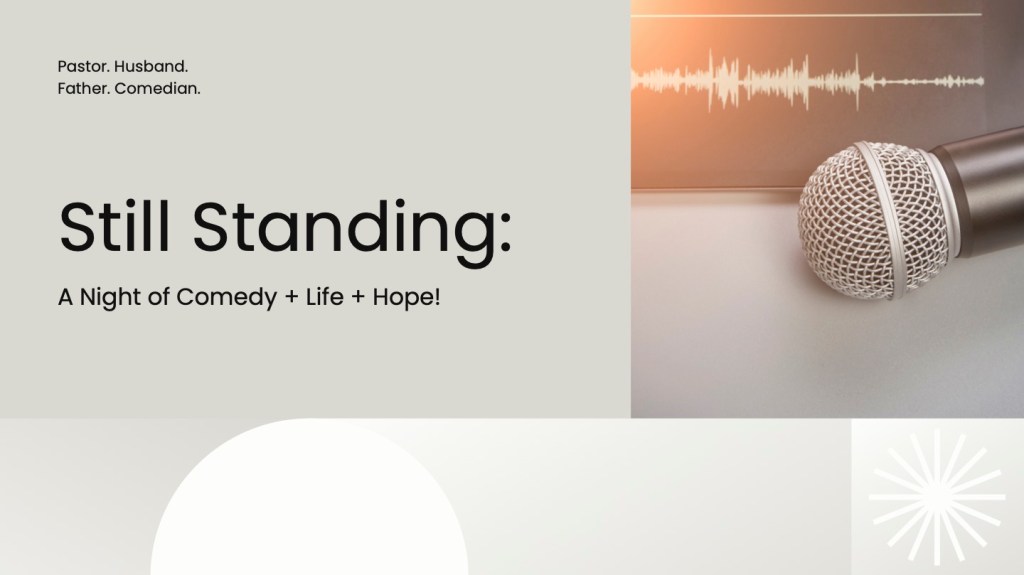
Still Standing: A Night of Comedy + Life + Hope

The 5-Day Humor & Hope Challenge

Building Resilience One Laugh, One Story, One Step at a Time

Let’s be honest: life can feel like a roller coaster you didn’t want to ride.

Some of us are raising teenagers, losing loved ones, trying to keep marriages alive, or just trying to get the dog to stop chewing Amazon boxes. (Why is cardboard the forbidden fruit for a dog?)

As a pastor for 25 years, a husband for 26 years, and a dad to two grown children, I’ve learned the hard way that life isn’t about avoiding the storm. It’s about learning how to dance in it, and sometimes laugh so hard you forget it’s raining.

That’s why I created the 5-Day Humor & Hope Challenge, a simple rhythm of encouragement to help real people (like you and me) build resilience through laughter, faith, and small honest steps.

If you’re tired, burned out, or just looking for something to lighten the load, this is for you.


Day 1: Own Your Mess—Then Laugh!

Let’s stop pretending we’ve got it all together. That’s exhausting. The truth is, some of your best moments, the things that bond you to other people, are the stories you’re tempted to hide.

Like the time I had to walk my mom (who had schizophrenia and Alzheimer’s) into her facility because we couldn’t provide care for her at our house. It was horrible. It was one of those moments where you curl up on the couch in the fetal position.

There wasn’t much in life that prepared me for those days. But laughter helped carry me through it.

Scripture: “A cheerful heart is good medicine…” (Proverbs 17:22)
Action: Tell someone your funniest hard story this week. Let them laugh with you, not at you.


Day 2: Laugh WITH Your Spouse, Not AT Them

Marriage isn’t built on perfect communication or flawless date nights. It’s built on punchlines, patience, and being willing to forgive each other when you forget to cancel that Amazon order for the third time.

We’ve had seasons in our marriage where it felt like the only thing keeping us together was the mess—but laughing with your spouse is a real gift!

Scripture: “Love bears all things, believes all things, hopes all things, endures all things.” (1 Corinthians 13:7)
Action: Think of one ridiculous memory that brought you closer. Text it to your spouse with a, “Can you believe we made it through that?”


Day 3: Give Grace to Your Family’s Weirdness

Every family is weird. Some are just better at hiding it.

But when you start giving grace instead of judgment, when you see your dad’s addiction or your mom’s mental illness through a lens of compassion, it opens the door for deeper healing and humor.

Resilience in families comes when we stop needing people to be perfect and start celebrating their progress.

Scripture: “Above all, love each other deeply, because love covers a multitude of sins.” (1 Peter 4:8)
Action: Say this prayer: “God, help me laugh more than I lecture today.” Then try it.


Day 4: Choose Hope When It Feels Optional

Hope isn’t passive, it’s practiced. It’s what you choose when you’ve buried people you love. It’s what you hold onto when you feel like giving up would be easier.

It’s not denial. It’s defiance against despair.

Scripture: “We have this hope as an anchor for the soul, firm and secure.” (Hebrews 6:19)
Action: Write down one hard thing you’ve made it through. Title it: “I’m still standing.” That’s your reminder.


Day 5: Share What’s Real (Not Just What’s Right)

People aren’t looking for polished faith. They’re looking for honest hope.

You don’t have to be the expert. Just be someone who’s still in it. Still praying. Still messing up. Still laughing. Still standing.

Scripture: “My grace is sufficient for you, for my power is made perfect in weakness.” (2 Corinthians 12:9)
Action: Call or message someone and say, “Can I tell you something real?” Then do it. That’s how light gets in.


Final Thought: You’re Not Failing—You’re Building Resilience

If you made it through this blog, guess what?
You’re doing better than you think.

You don’t have to be perfect. You just have to keep showing up, with a little more grace, a little more grit, and maybe a little more laughter.

And if you ever need someone to remind you that God still works through broken people with Costco outfits, I’m your guy.

Essential Parenting Truths for Today’s Struggling Families

My wife and I have worked in pastoral ministry for over 20-years.  My wife has worked in personal counseling as a Licensed Professional Counselor for 10 of those years.  A common theme in parenting we have noticed is that the pressure of parenting is at an all time high.

All the studies today on children show that children are feeling more pressure to succeed, they carry more anxiety, they struggle to know how to respond to challenges in life and the overwhelming answer for our children from parenting resources today seems to be on the parents doing more to help their children navigate these challenges.

Parents are already being asked to do the normal expectations of parents: provide a roof over their head, consistent income, clothes to wear, and food to eat.  And now the parent is being challenged to make sure their children are in the extra-curricular activities from the age of 5 if they want to be on the “team” in high school, provide tutoring for academics, expose their children to healthy eating options, ask probing and insightful questions to help children process emotions, launch a technical division in their home to be on guard against online predators, teach their children how to process their anxiety, so that children can launch into the world as well-rounded human beings.  It’s impossible!

Oh yeah, those parents are also trying to launch a successful career, build a healthy marriage, take care of their physical health, and be responsible for all the hiccups in life like flat tires, a leaking roof, and paying bills.  It’s a lot!

During the pandemic my wife and I wanted to do something productive with our time, so we went through foster-training so that we could foster a child.  Our biological children were in their teens, needing less of our time, so we took this as a growth opportunity for our family.  

Our intent was never to adopt the child but play a small part in reunification for the family.  When the social workers talked about the base level factors for reunification they said, “We are looking for 3 things in every home; roof, access to food and water, and a place to sleep.”  My wife and I thought to ourselves, “We are trying way too hard as parents!”

Don’t get me wrong.  I know roof, food, and bed are base level expectations for parenting but in my experience children are incredibly resilient.  And the best parenting experience isn’t going to be able to create a childhood for our children that enables them to avoid every traumatic experience in life.  Did you catch that? 

The best parenting on the best day isn’t going to be able to avoid every difficult challenge for our children, therefore, it seems like we could put less pressure on parents and instead encourage parents with some basic principles.  Here are a few that we have applied to our family. (If the average parent is trying to improve their parenting through books, podcasts, blogs, and personal reflection they are a great parent!)  

  1. Dad and mom put their hope in the Lord.  It’s easy to get excited when our children start to read.  We think to ourselves, “Our child might be the smartest child to ever walk the earth.”  Then our children display some quality of athleticism, attraction and the excitement for our children grows and grows but one thing is sure for all parents: our children will encounter hardship in life.  It might be emotional hardship, physical hardship or mental hardship.  It might come early, or it might start to show signs during their early twenties.  When a parent puts their hope in their children then that parent is putting their hope in shifting sand that no child is going to be able to sustain.  Rejoice in your children!  But, let us all put our hope in the Lord because it won’t be long until the limitations of our children will be exposed in their humanity and in that moment we will be looking for / needing something more secure than our children.
  2. Dad and mom are committed to one another in marriage. This isn’t a magical guarantee, but if the average child gets to see a male and female experience in the home, they are gaining an incredible opportunity that will serve them the rest of their life.  Can single-parents do a great job of raising children?  For sure!  But if you are married, or plan to get married, the best gift you can give to your child is a dad and mom committed to one another in marriage. Here’s a great resource to help strengthen your marriage!
  3. Dad and mom are committed to furthering the family.  Again, it isn’t a magical guarantee, but if the average child gets to see mom and dad working to sustain, persevere, improve, and strengthen their family unit, then they are gaining an incredible opportunity that will serve them the rest of their life.  The fact that you have read this much of this article is evidence that you are committed to furthering your family!  Rejoice!
  4. Dad and mom are in a growing relationship with God through faith in Jesus.  The concept of a person committing their life to Jesus implies this person has humbled themselves to admit they don’t have all the answers in life.  This trait alone can do more for that child than any other belief system because the parent isn’t modeling an example of someone who has it all figured out but instead the parent is modeling an example of someone who admits they need help from Jesus. That’s the gospel!
  5. Dad and mom have a grounded belief that God is sovereign in all things. I bet you are thinking, “I thought this was about parenting?”  It is!  When dad and mom are centered on some foundational areas of life, you can miss a lot of other areas of life but this one is a big one, because life is going to happen.  Jobs are going to be lost.  People are going to get sick.  Problems are going to come up.  But, when dad and mom are convinced that God is sovereign over all areas of life, even the painful parts of life, it is going to dramatically shape how dad and mom respond to those hard times and approach parenting. Here’s a great resource to help us trust the Lord in those hard seasons.  
  6. Dad and mom have a clear vision, purpose and goals for their family.  Every business has stated vision and goals for why they exist as a company.  Every family is a little company and the more parents can articulate why decisions are being made in the family the better it will be for their children to know the meaning behind the decisions that are being made as a family.  Here’s a great resource to help with personal planning.
  7. Dad and mom keep the main things the main things with parenting.  This list is the main thing.  Everything else is peripheral.  Pick a school for them to attend.  Encourage them in their hobbies and interests.  Make sure they have a roof over their head, some clothes to wear, access to food and everything else is a flip of the coin.  I can’t stress this enough.  The best attempt at parenting can still create huge deficits in parenting.  The parent who wants to make sure their child is encouraged in all areas of life might have a child that feels like their parents smothered them.  The parent who is involved in the life of their children might have a child that felt restricted.  The parent who is generous with their child might have a child that takes advantage of their generosity.  The parent who is “hands-off” in discipline might have a child that needs “hands-on.”  None of our children come with instructions and none of them are able to tell us what they need to help them become a fully functioning adult.  It doesn’t mean all the accessories don’t matter.  It just means there are too many moving parts to put too much weight into any accessory we bring into their life.  Here’s a simple guide but it’s just a guide:
    • 0-2:  CARE (We are letting them know they are loved and cared for in life.)  
    • 3-5:  CONSTRUCT (We want to provide a structure for children to thrive.)
    • 6-11:  COUNSEL (Help draw out their thoughts, emotions, and experiences.)
    • 12-18:  CONTEND (Fight for them to apply what you have learned as you prepare them to launch.) 
  8. Dad and mom trust that their children are His children, their story is His story.  Every parent is building a story for their children from the moment they are conceived.  Dad and mom are imagining graduations, parties, friends, events, weddings, romance, bike rides, vacations and some dads and moms are aware of those longings and some dads and moms aren’t aware but it is a guarantee that 100% of those longings won’t be realized.  Some of that reality will happen early in life and some of that reality might happen slowly throughout the life of the child, but at the end of the day every parent has to let go of “their story” for their children and trust in God’s story for their children.  It’s great to pray, plan and prepare but the parent must hold all those plans with an open hand and trust that the Lord will write a story that is better than what we had planned.
  9. Dad and mom are thankful for every second dad and mom get with their children. Some people never get to experience parenthood.  Parenthood isn’t a promise for every person.  Some parents only get to experience parenthood for seconds.  And some parents will get 60+ years of parenthood but the best response any parent can have is gratitude for every second.  
  10. Dad and mom must layer themselves in humility.  Dad and mom are invited to faithfully build into their children but let us not think too highly of ourselves.  Our children are not 50% dad and 50% mom.  Our children are a collection of 400 different people in their genetic system with influences that are greater than our parenting skills.  Throughout the history of Israel we see Israel received instruction from the Lord, miracles, intimacy, etc. and yet Israel turned from the Lord over and over, therefore, how much more should we not be surprised if our children will turn from our parenting at some point in life or on some level.  In Judges 5 we see a practical example of some tribes of Israel who respond to God’s invitation to spiritually wake up and follow Him, and there are some tribes of Israel who stay spiritually asleep and ignore Him, therefore, how much more are we as parents to assume the same could happen with our children. 

Bonus: What happens when our children turn from the Lord?  When a child shows a lack of interest in the Lord the parent’s natural assumption is, “What did we do wrong?”  Biblically we know it is the Lord who draws hearts.  It is the Lord who opens eyes.  It is the Lord who calls us to faith in Jesus but because a parent loves their child so much they will think to themselves, “If I would have / haven’t (fill in the blank) then maybe the child would have more interest in the Lord?”  Maybe there are things for us to learn about our parenting choices? But we can’t dwell in this area too deeply or too frequently.  Could a parent have done more?  Sure!  But ultimately it is the Lord who has to write that story of His grace in their life and as a parent, like our children, we are invited to put our trust in Him.