
Tag Archives: hope

Getting Over Grumpiness: How to Stop Resenting Where You Are While Still Hoping for More

Everyone has a season of life where we start to feel grumpy: We want our marriage to feel closer, but every week feels like the same argument. We want our job to be meaningful, but Sunday night still feels like dread. We want our parenting to be calmer, but we keep losing our patience at the same places. And we end up living in this exhausting middle space: We hope things will get better, but it doesn’t feel like anything will actually change.

Most people don’t even know how to talk about this tension. They assume the frustration means something is wrong with them. Or they plataue into mediocrity, convincing themselves nothing will ever change.

But the real issue isn’t desire or effort, or Steve at work always talking about the best way to roast coffee beans for the 27th time. The real issue is how we hold the hope for change and the reality of where we are, without getting stuck in an eternal state of grumpiness.

It starts with being CONTENT so that we are able to find HOPE.

If a person is internally unsettled about an area of life, their hope isn’t really hope, it’s desperation. It’s a Hail Mary. It is in those moment that we rush decisions. We cling to an outcome that has to happen, or else! Of course we are filled with anxiety, because it all has to work together the way we want, when we want, and how we want.

In addition, taking steps toward being content with where we are in life of our career, marriage, health, finances, friends is the first step to accepting that we don’t need to change to be okay.

This doesn’t mean we shouldn’t have goals in life. There’s nothing wrong with goals. It’s great to have dreams, but before we get to goals and dreams we want to combat the lie that says, “I will be okay when this or that happens in my life.”

The power of being content breaks that lie and says, “I am okay with who I am today, even if nothing ever changes.” Take a second just to consider the weight of that statement. Do you enjoy the person you are today? Do you enjoy the quality of your marriage, health, finances, children, and career today? If nothing ever changed in those areas, would you be content? If not, we will always set ourselves up for the “next big thing.”

When we are ready to accept where we are in life and who we are in life we are able to see hope enter into the story of our life. Now, after we’ve done the work of being content we can see that hope isn’t a condition for us to pursue, but instead, hope is simply fuel for us to enjoy the possibility of what might come in the days ahead.

HOPE isn’t mandatory of what HAS TO HAPPEN, but instead, hope is FUEL for what MIGHT HAPPEN!

Hope interpreted as a necessity becomes a weight that can feel like pressure, which creates anxiety. But if we start with contentment, then hope becomes empowering, not condemning. The sequence matters because your value as a person isn’t dependent on the results. You can dream about a brighter future but you’re not held hostage by that dream. Here are 5 principles to help us remember:

  1. Finding contentment with who we are and where we are removes the panic that something has to change. When we are panicked in life, then every conversation feels like an emergency.
  2. Finding contentment with who we are and where we are removes the frustration we have toward life. When it comes to our marriage, health, career, children, finances; we don’t have to hate where we are to build a better tomorrow.
  3. Finding contentment with who we are and where we are brings clarity, so that hope is given clearer direction. It is in those moments that we stop chasing cobwebs and go kill the spider!
  4. Finding contentment with who we are and where we are removes the pressure. As long as we feel “behind” as a person or in an area of life we are going to be fueled by outside circumstances. Instead, we want to release hope to be a preferred future that doesn’t have to happen.
  5. Finding contentment with who we are and where we are is accessible today. Nothing has to change. It’s totally perspective. It’s this transition that allows hope to shape a long-term process of growth.

At the end of the day, getting over grumpiness isn’t about pretending everything is fine or forcing yourself to feel optimistic. It’s about remembering that you can be grounded in who you are and where you are today, while still moving toward a better tomorrow.

Contentment gives you the peace to breathe again; hope gives you the courage to take the next step. And when those two work together, you stop waiting for life to change before you show up to it. You start living today with the freedom and clarity you thought only existed in the future.

How to Live This Today (Simple, Practical Application)

Step 1 — Name the area where you’re frustrated.

Marriage.
Career.
Health.
Finances.
Parenting.

Step 2 — Say this sentence out loud:

“I can be grounded and settled with who I am and where I am, even if nothing changes today.”

Step 3 — Identify ONE hopeful action.

  • One honest conversation.
  • One boundary.
  • One habit.
  • One budget move.
  • One apology.
  • One walk.
  • One resume sent.
  • One evening without your phone.

References to consider:

  1. Philippians 4: Peace and pursuit held together through contentment.
  2. Edwin Friedman, “A Failure of Nerve.”
  3. Dallas Willard, “Renovation of the Heart.”
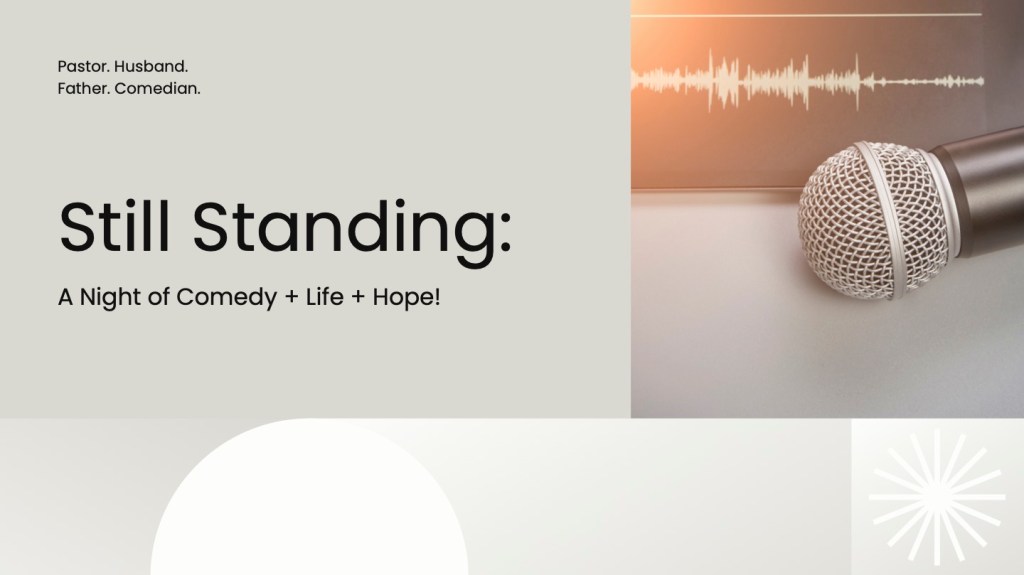
Still Standing: A Night of Comedy + Life + Hope

The 5-Day Humor & Hope Challenge

Building Resilience One Laugh, One Story, One Step at a Time

Let’s be honest: life can feel like a roller coaster you didn’t want to ride.

Some of us are raising teenagers, losing loved ones, trying to keep marriages alive, or just trying to get the dog to stop chewing Amazon boxes. (Why is cardboard the forbidden fruit for a dog?)

As a pastor for 25 years, a husband for 26 years, and a dad to two grown children, I’ve learned the hard way that life isn’t about avoiding the storm. It’s about learning how to dance in it, and sometimes laugh so hard you forget it’s raining.

That’s why I created the 5-Day Humor & Hope Challenge, a simple rhythm of encouragement to help real people (like you and me) build resilience through laughter, faith, and small honest steps.

If you’re tired, burned out, or just looking for something to lighten the load, this is for you.


Day 1: Own Your Mess—Then Laugh!

Let’s stop pretending we’ve got it all together. That’s exhausting. The truth is, some of your best moments, the things that bond you to other people, are the stories you’re tempted to hide.

Like the time I had to walk my mom (who had schizophrenia and Alzheimer’s) into her facility because we couldn’t provide care for her at our house. It was horrible. It was one of those moments where you curl up on the couch in the fetal position.

There wasn’t much in life that prepared me for those days. But laughter helped carry me through it.

Scripture: “A cheerful heart is good medicine…” (Proverbs 17:22)
Action: Tell someone your funniest hard story this week. Let them laugh with you, not at you.


Day 2: Laugh WITH Your Spouse, Not AT Them

Marriage isn’t built on perfect communication or flawless date nights. It’s built on punchlines, patience, and being willing to forgive each other when you forget to cancel that Amazon order for the third time.

We’ve had seasons in our marriage where it felt like the only thing keeping us together was the mess—but laughing with your spouse is a real gift!

Scripture: “Love bears all things, believes all things, hopes all things, endures all things.” (1 Corinthians 13:7)
Action: Think of one ridiculous memory that brought you closer. Text it to your spouse with a, “Can you believe we made it through that?”


Day 3: Give Grace to Your Family’s Weirdness

Every family is weird. Some are just better at hiding it.

But when you start giving grace instead of judgment, when you see your dad’s addiction or your mom’s mental illness through a lens of compassion, it opens the door for deeper healing and humor.

Resilience in families comes when we stop needing people to be perfect and start celebrating their progress.

Scripture: “Above all, love each other deeply, because love covers a multitude of sins.” (1 Peter 4:8)
Action: Say this prayer: “God, help me laugh more than I lecture today.” Then try it.


Day 4: Choose Hope When It Feels Optional

Hope isn’t passive, it’s practiced. It’s what you choose when you’ve buried people you love. It’s what you hold onto when you feel like giving up would be easier.

It’s not denial. It’s defiance against despair.

Scripture: “We have this hope as an anchor for the soul, firm and secure.” (Hebrews 6:19)
Action: Write down one hard thing you’ve made it through. Title it: “I’m still standing.” That’s your reminder.


Day 5: Share What’s Real (Not Just What’s Right)

People aren’t looking for polished faith. They’re looking for honest hope.

You don’t have to be the expert. Just be someone who’s still in it. Still praying. Still messing up. Still laughing. Still standing.

Scripture: “My grace is sufficient for you, for my power is made perfect in weakness.” (2 Corinthians 12:9)
Action: Call or message someone and say, “Can I tell you something real?” Then do it. That’s how light gets in.


Final Thought: You’re Not Failing—You’re Building Resilience

If you made it through this blog, guess what?
You’re doing better than you think.

You don’t have to be perfect. You just have to keep showing up, with a little more grace, a little more grit, and maybe a little more laughter.

And if you ever need someone to remind you that God still works through broken people with Costco outfits, I’m your guy.

Why Do We Sing the Song “Joy to the World?”

Joy to the world, the Savior reigns, let men their songs employ, while fields and floods, rocks, hills and plains, repeat the sounding joy, repeat the sounding joy, repeat, repeat the sounding joy

He rules the world with truth and grace, and makes the nations prove, the glories of His righteousness, and wonders of His love, and wonders of His love, and wonders and wonders of His, His love


Photo by Pixabay on Pexels.com

“Joy to the World” was written by Isaac Watts who was born in 1674 in Southampton, England.  He wrote over 750 hymns including, “When I Survey the Wondrous Cross, This is the Day the Lord Has Made, and Sin Has a Thousand Treacherous Arts.”  

Watts was actually bleeding edge in his time.  As a teenager he would always complain about the music and the lack of participation from the people.  So, his father challenged him to do something. The following week he wrote, “Behold the Glories of the Lamb” and the people began to engage in the worship as he involved an emotional and theological influence in the worship.  Isn’t that fascinating?

Today, “Joy to the World” is the most published Christmas song to date, but until we see the theological truths layered in the song I think we are missing out.  Let’s look at Romans 8 to see where this song comes from.  

Romans 8:18 For I consider that the sufferings of this present time are not worthy to be compared with the glory that is to be revealed to us.

In the context of the passage, verse tells us there is new life in Jesus, there is victory in Jesus, there is freedom from sin, life-changing transformation that is glorious, but in verse 18 it also says, “There is suffering.”

It means there are people all over the world who are enjoying friends and family, having fun, enjoying rest and seeing God do great things in their life, but there are also some people all over the world who are suffering.  

How can we sing a song called “Joy to the World” when we are surrounded by suffering?  Verse 18 speaks of “glory that is to be revealed.”

This is why the song says, “Joy to the world, let earth receive her king, let heaven and nature sing, let men their songs employ, while fields and floods, rocks, hills and plains, repeat the sounding joy.”

This song isn’t just about fuzzy, warm moments around the holidays.  The song is about a baby that has come as king, lives a perfect life, takes all sin upon Himself, so that in Him, through faith, we are set free into the freedom of glory that will permeate every part of creation.  

But how does the hope of His glory lead to joy?  Imagine you are going to put two people in two rooms and give them identical tasks that are menial, boring, and difficult manual labor.  You tell them both, “You are going to work 40-hours a week, for 12-months, and no vacations.  It is going to be boring.  It is going to be tedious, and it is going to be really hard.  

To the first person you say, “At the end of the 12-months you will get an annual salary of $12,000.”  To the second person you say, “At the end of the 12-months you will get an annual salary of $12 Million.”

The first person is going to go at it for about 3-4 weeks and say, “I quit. This is too hard.  This is driving me crazy.”  But, the other person is going to say, “Done!  Not a problem, 12-months, are you kidding and whistling the whole day, every day, at work.”  Why?  The tedious trial is being overshadowed by the glory that is to be revealed.  

God’s Word teaches us, “We might get to live on this planet for 80+ years, and while we are here we will encounter suffering.  There are going to be hard days, but in verse 18 we see, “These hard days are nothing compared to the glory that is to be revealed.” 

Where is your joy?  Is it in romantic relationships that come and go?  Is your joy in the economy that is up and down?  Is your joy in how others perceive you?  What torture!

God’s Word invites us to put our joy in Jesus.  Jesus is the One who is full of power.  Jesus is the One who has come to call you His.  Jesus is the One who will return again to make all things new.  

This is why Isaac Watts writes down the words, “Joy to the World.”  It isn’t just what happens at the incarnation, it isn’t just the resurrection, it isn’t just the sanctification, but soon there is coming our glorification for the whole universe.